

How to Play Fish Table Games: A Step-by-Step Guide
Published Oct 11, 2026
Casino
Key Takeaways
- Playing a fish table game comes down to five repeating steps: pick a weapon, set your bet level, aim, fire, and watch the result, with a bonus event layer running on top.
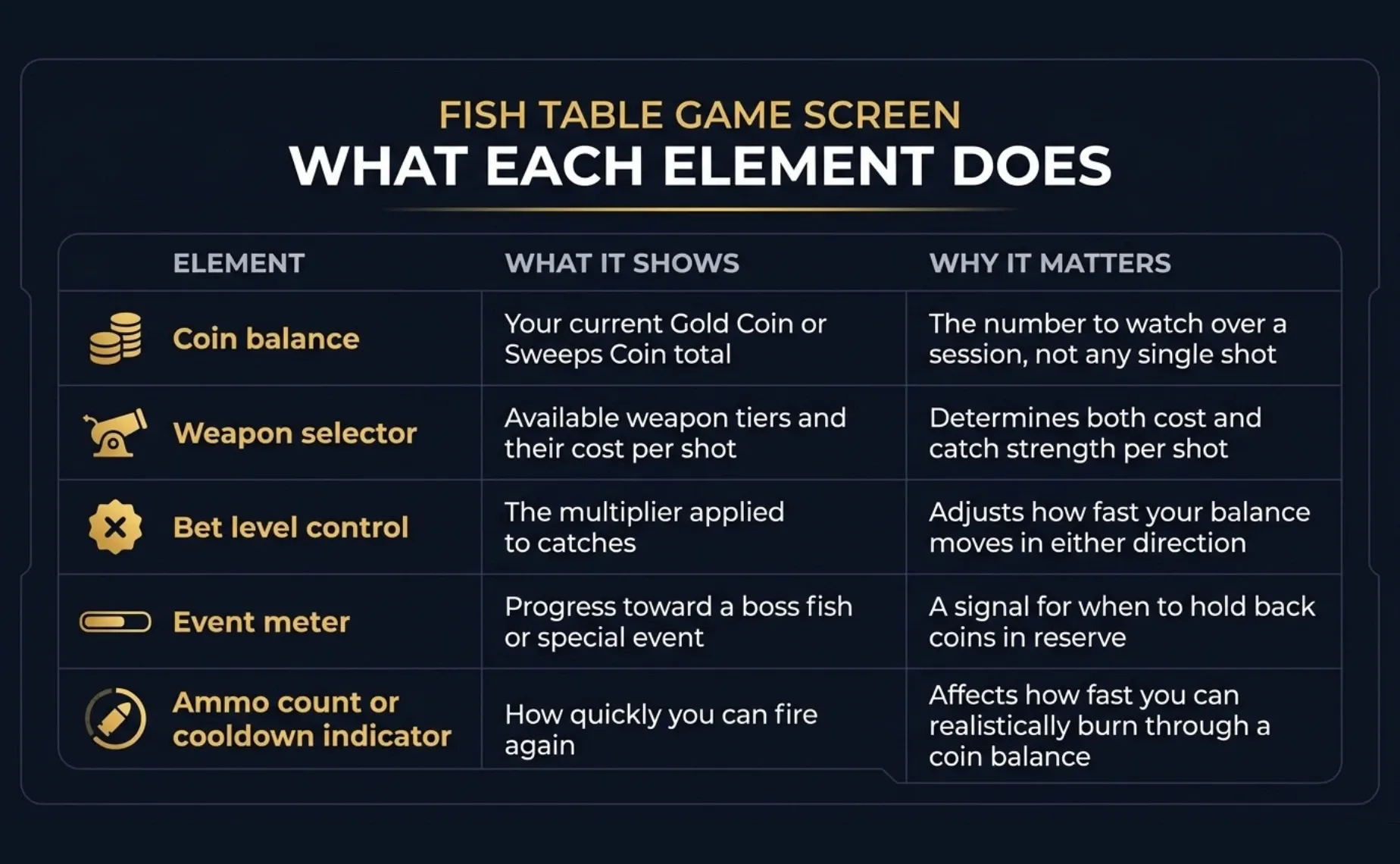
- Most of the screen real estate is information you'll want to check before you start: coin balance, bet level, weapon tier, and any event meter tracking a boss fish.
- On a sweepstakes casino, you'll typically start in Gold Coin mode, which is the easiest way to learn a new title's layout before using Sweeps Coins.
- There's no login sequence or setup unique to fish tables beyond what any other game on the platform requires; the learning curve is entirely about the in-game controls.
- Knowing what each button and indicator does before your first real session saves you from the confusion that usually causes new players to misjudge a game in the first few minutes.
A fish table game looks intimidating the first time you open one. There's a busy underwater scene, multiple weapon icons, a bet selector, a coin counter, and often some kind of event bar building toward something. None of it is complicated once you know what you're looking at, and most of the apparent complexity is really just a handful of repeating elements dressed up in different arcade-style skins from one title to the next. Here's the actual sequence of steps, from opening the game to understanding what happened at the end of a session.
Step 1: Start in Gold Coin Mode
Before touching Sweeps Coins, open the fish table title in Gold Coin mode if the platform offers it. This isn't a formality. Fish table games vary quite a bit from one title to the next in fish speed, screen layout, and weapon design, and the only way to learn a specific game's rhythm is to actually play it. Gold Coin mode lets you do that without any prize-related stakes attached.
Need coins to start with? Here’s how to get free Sweeps Coins.
Spend at least a few minutes here just watching how fish move before you start shooting. Notice which fish appear most often, how fast they cross the screen, and whether there's a visible timer or meter suggesting a bonus event is building.
Step 2: Choose Your Weapon
Most fish table games offer a row of weapon icons, usually ordered from weakest and cheapest to strongest and most expensive. Your weapon choice determines two things: how much each shot costs in coins, and how much damage or catch probability boost that shot carries against a given fish.
For a first session on a new title, starting with a low or mid-tier weapon is almost always the more sustainable choice, even if the flashier top-tier weapon icon is tempting to click first. It costs less per shot, which means more total shots from the same coin balance, and it's usually enough to catch the small and mid-size fish that make up most of what's on screen at any given moment.
Step 3: Set Your Bet Level
Separately from weapon choice, most titles let you adjust a bet level or coin value per shot, which acts as a multiplier on whatever you catch. A higher bet level means a bigger payout per fish, but it also means your weapon's base cost per shot goes up accordingly.
This is the lever to adjust based on how long you want a session to last. Lower bet levels stretch a coin balance across more shots; higher bet levels get you closer to a bigger payout per catch but drain your balance faster if your shots aren't connecting.
Step 4: Aim and Track a Target
This is the part that's genuinely different from a slot. Fish move continuously across the screen in different directions, speeds, and patterns. On most platforms, you aim with a cursor, a touch-drag, or a joystick-style control depending on the device, and fire with a separate button, tap, or click.
A few practical habits for this step:
• Pick a specific fish and track its movement for a second before firing, rather than firing at wherever your cursor happens to be.
• Lead your shot slightly ahead of a fast-moving fish's direction, since there's often a small delay between firing and the shot reaching the target.
• For schooling fish that cluster together, aiming at the center of the group gives you the best chance of a shot affecting more than one.
Step 5: Fire and Read the Result
When your shot connects, one of two things happens: the fish is caught, and you're credited coins based on its point value and your bet level, or the shot misses or doesn't generate a catch, and nothing happens beyond the ammo cost. This is governed by the game's underlying random outcome system, not purely by whether your shot visually looks like it hit the target. Curious how that works? Here’s what RNG means in casino games.
Watching your coin balance after a string of shots, rather than reacting to any single shot, gives you a much better read on how a session is actually going. A handful of shots tells you very little; a longer stretch starts to show you the game's real behavior.
Step 6: Watch for Bonus Events
Most fish table games build toward some kind of special event, commonly a boss fish, a golden or multiplier fish, or a screen-wide effect like a freeze or lightning chain. These are usually signaled with a visible meter, a countdown, or a noticeable change in the game's music or animation.
Pay attention to these cues. If you notice a meter building, it's often worth holding back part of your coin balance so you have enough left to meaningfully participate when the event actually triggers, rather than running low right beforehand.
Step 7: Adjust as You Go
Nothing about your weapon, bet level, or target choices is locked in for the whole session. If a particular weapon tier doesn't feel like it's connecting often enough, or if you notice the game favors a certain fish type at your current bet level, adjust. The ability to change your approach mid-session, based on what you're observing, is one of the more useful aspects of this game format compared to a slot, where your main lever is just bet size.
Step 8: Decide When to Stop
Since fish table games are continuously active rather than paced out like slot spins, it's easy to lose track of time. Setting a loose plan before you start, whether that's a coin budget, a time limit, or a specific number of sessions, helps keep the experience feeling like entertainment rather than something that quietly runs longer than intended.
A Typical First Session, Walked Through
Putting the steps together, a reasonable first session on a new fish table title might look like this: open the game in Gold Coin mode, watch for 30 to 60 seconds without shooting, select a low or mid-tier weapon, set a moderate bet level, and spend the first 50 to 100 shots focused on mid-size fish rather than chasing the biggest target on screen. Note roughly how often shots connect at that weapon tier, and pay attention to whether any bonus event triggers during that window.
From there, you'll have a real sense of the title's pacing, which makes the decision to move into Sweeps Coins, if you choose to, a much more informed one than jumping in without any of that context.
Why Your Shots Might Not Be Connecting
New players often assume a weapon is "broken" or a game is unfair when a string of shots doesn't produce a catch. A few more likely explanations are worth ruling out first:
- Weapon tier mismatch. A low-tier weapon has a lower catch probability against larger or faster fish by design. If you're consistently aiming at bigger targets with a starter weapon, missed shots are expected, not a sign of a problem.
- Timing lag. Depending on your connection and the game's animation speed, there can be a slight delay between where you aim and where the shot actually registers. Firing slightly ahead of a moving target compensates for this.
- Normal variance. Just like a slot spin, each shot's outcome is governed by probability. A cold stretch of several shots without a catch is well within expected variance, especially against higher-value fish with lower catch rates.
- Screen clutter. On a busy screen with many overlapping fish, you may be aiming at a different fish than you think, especially on a smaller mobile screen. Zooming in or switching to a less crowded moment can help.
Working through this list before assuming something is wrong saves a lot of frustration, and it mirrors the same troubleshooting mindset that applies to a "cold" slot: short-term results don't tell you much on their own.
Slots have cold stretches too. Here’s slot volatility explained.
Single-Player vs. Multiplayer Online Tables
Most fish table games on sweepstakes casino platforms today are single-player, meaning the steps above apply to your own private screen of fish. A smaller number of platforms offer online multiplayer versions that recreate the original shared-table format digitally, where several players see the same fish at once and can compete for the same boss fish or event.
If you do encounter a multiplayer version, a couple of the steps shift slightly. Target selection becomes more time-sensitive, since another player might catch the fish you're tracking first. Bonus events, like a boss fish, may pay out based on who lands the final hit or who contributed the most damage, rather than being guaranteed to you individually just because you're participating. The core mechanics of aiming, firing, and watching the result stay the same either way.
Want the history behind the shared tables? Read what fish table games are.
Setting Up Your Session Before You Start Shooting
A few minutes of setup before Step 1 makes the rest of the process smoother:
- Check your connection. Fish table games are visually active and benefit from a stable connection, since lag directly affects your ability to time shots against moving targets.
- Adjust display settings if available. Some titles let you adjust screen brightness, fish animation speed, or sound effects independently from your device settings, which can make tracking targets easier.
- Review the specific title's weapon list. Weapon names and tiers aren't standardized across every fish table game, so a quick look at what's available in this specific title avoids assumptions carried over from a different game.
- Decide your session plan in advance. A loose budget or time limit decided before you start is far easier to stick to than one decided mid-session.
New to GoldenDragon.Casino? Use code DRAGON20 for 20% off when eligible. Limited to one use per user, valid through January 1, 2030.
Understanding the Screen Layout
Different titles arrange their interface differently, but most fish table games share a common set of elements worth knowing by sight:
A Second Walkthrough: Moving Beyond the Basics
Once the first-session approach above feels comfortable, a slightly more deliberate session might look different. Instead of spending the whole session on one weapon tier, you might start on a low tier to clear out small schooling fish efficiently, then switch to a mid or high tier specifically when a boss fish event starts building, since that's the moment where a stronger weapon's higher catch probability matters most.
This kind of weapon-switching requires watching two things at once: your current coin balance and the event meter. It's a habit that takes a session or two to build, since the instinct when a boss fish appears is often to fire immediately rather than pausing briefly to switch weapons first. Players who get used to this rhythm tend to describe fish table sessions as feeling more like a short tactical decision loop than a repetitive button-press activity. See how fish games compare to slots in our fish games guide.
Switching Between Different Fish Table Titles
If a sweepstakes casino's library includes several fish table games, the steps above apply to each one individually, but the specific numbers (weapon costs, fish values, event frequency) will differ from title to title. Treat every new title as its own learning process rather than assuming your weapon-switching timing or targeting habits from one game will transfer perfectly to another.
A practical way to handle this: whenever you open a fish table title for the first time, repeat Steps 1 through 3 above (Gold Coin mode, weapon choice, bet level) as if you'd never played a fish table game before, even if you're experienced with the genre overall. The underlying loop is the same, but the pacing and visual cues are specific to each game.
Reading Your Results After a Session
After you've finished playing, it's worth taking a moment to look back at how the session actually went, rather than moving straight into another game. A rough sense of your starting and ending coin balance, which weapon tiers felt most efficient, and whether any bonus events triggered gives you something concrete to apply the next time you open that same title.
This isn't about keeping detailed records. It's closer to the kind of casual self-check you'd do after trying a new recipe or route to work: noting what worked and what you'd adjust, so the next attempt benefits from the last one.
Wondering what winning really means here? Read how to win fish table games.
Playing on Different Devices
The steps above are the same whether you're on a phone, tablet, or desktop browser, but the controls themselves differ. On mobile, aiming is usually a tap or drag gesture; on desktop, it's typically mouse movement with a click or keypress to fire. If a title offers adjustable aim sensitivity, it's worth tuning that in the settings menu before a real session, since the default setting isn't always well calibrated for every screen size.
Frequently Asked Questions
1. What are fish table games?
Fish table games are arcade-style shooting games, originally built into shared multiplayer cabinets, where players use a virtual weapon to catch on-screen fish worth different point values. Online and sweepstakes casino versions keep the same core mechanics in a typically single-player format.
2. How does sweepstake casino work?
A sweepstakes casino uses two currencies: Gold Coins for play-for-fun gaming with no prize attached, and Sweeps Coins, obtained through no-purchase-necessary methods or promotions, which can be redeemed for a prize according to the platform's official rules.
3. Do I need to purchase anything to play fish table games?
No. Gold Coins let you play for fun without any purchase, and Sweeps Coins are available through no-purchase-necessary methods described in a platform's official rules. Optional purchases of Gold Coin packages, which may include bonus Sweeps Coins as a promotional gift, are never required to play or to have a chance at a prize.
4. Is there a single correct way to aim in fish table games?
There's no universally correct technique, since it depends on the specific title's fish speed and screen layout, but tracking a target briefly before firing and leading fast-moving fish slightly ahead of their path tends to connect more consistently than firing reactively at whatever crosses the cursor.
5. How can I get free sweeps coins to try a fish table game?
Common no-purchase-necessary methods include daily login bonuses, mail-in or email entry requests described in a platform's official rules, and occasional promotions. Bonus Sweeps Coins are also often included with optional Gold Coin package purchases, though the coins themselves are never sold directly.
6. Are sweepstakes casino slots easier to learn than fish table games?
Slots generally have a shorter learning curve since the main decision is bet size, while fish table games involve more active decisions around aiming, weapon choice, and timing. Neither is inherently better; it depends on whether you prefer a more passive or a more interactive style of play.
7. What should a complete beginner do in their very first fish table session?
Open the game in Gold Coin mode, spend a minute watching fish movement without shooting, pick a low or mid-tier weapon, set a moderate bet level, and focus on mid-size fish rather than immediately chasing the largest target on screen. This gives you a feel for the title's pacing before any coins with prize value are involved.
8. Do fish table games work the same way on every sweepstakes platform?
The general steps (weapon selection, bet level, aiming, firing) are consistent across the genre, but specific fish values, weapon costs, and event frequency vary by title and by platform. Treating each new title as its own short learning curve, even if you've played fish table games elsewhere before, avoids misapplied assumptions.
Summary
Playing a fish table game is really a loop of five steps repeated continuously: choose a weapon, set a bet level, aim, fire, and read the result, with an eye on any bonus event building in the background. None of it requires anything beyond what's visible on screen once you know what each element represents. Starting in Gold Coin mode, watching before shooting, and adjusting your weapon and bet level as you learn a title's pacing will get you through the learning curve far faster than jumping straight into a session at full speed.
Once you're comfortable with the basic controls, looking into specific tips for managing coins and targeting efficiently is a natural next step, and it's usually where the real improvement in how long a session lasts and how satisfying it feels actually happens, more so than from any single mechanical adjustment covered in these steps. Give yourself a few sessions before judging whether a title, or the genre as a whole, is for you; the first ten minutes with any new control scheme rarely reflect how comfortable it'll feel once the steps above become second nature.
Ready for the next step? Read our fish table game tips.